
Share This
Some appetizers get politely picked at. These get hunted.
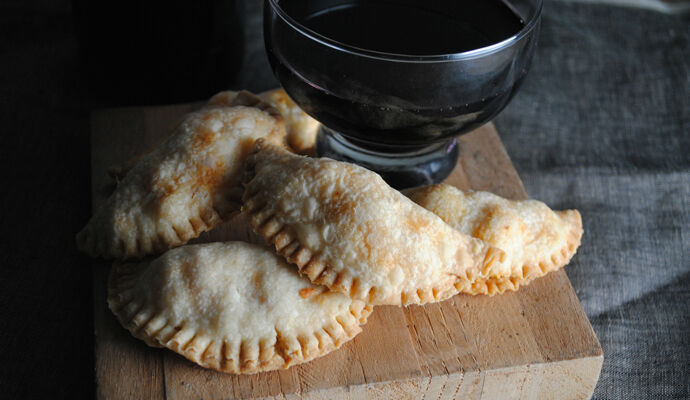
Mini potato-chorizo empanadas are bite-sized hand pies filled with spiced Mexican chorizo and tender diced potato, folded into pastry and baked until the edges blister and go golden. The best part is how little they ask of the person making them. There is no dough to rest, no fryer to heat, no technique to master beyond crimping an edge with a fork. A package of refrigerated pie crust and a four-inch cookie cutter get most of the way there, which leaves time for the part that actually deserves attention: what goes in the glass.
Chorizo brings fat, salt, and a slow wave of paprika heat. That combination needs a wine with enough acidity to cut clean through it and enough restraint to stay out of the spice's way. Kendall-Jackson AVANT Chardonnay does both, and served cold enough to fog the glass, it turns a tray of appetizers into the reason people stay standing in the kitchen.
Empanada Dough: Store-Bought vs. From Scratch
Purists will say empanadas deserve homemade dough. Purists are also not the ones assembling four dozen of these while guests are already parking outside.
Refrigerated pie crust is the shortcut this recipe is built around, and it works because the ratio is forgiving. Pie dough is rich, flaky, and already rolled to roughly the right thickness, so it needs nothing more than a four-inch cookie cutter and a rolling pin to stretch it into a fifteen-inch circle. It bakes into something closer to a savory hand pie than a traditional empanada, which is not a compromise so much as a different pleasure. Two crusts yield ten to twelve minis.
- Frozen empanada discos are the middle path and arguably the smartest one. Sold in the Latin freezer section under brands like Goya, they come pre-cut into perfect rounds, thaw in about twenty minutes, and are formulated to hold a wet filling without tearing. They also come in baking and frying varieties, so the label matters. For a tray headed into a 350-degree oven, reach for the baking discos.
- Homemade dough is worth the effort exactly once, and then only for people who enjoy that sort of Saturday. Flour, butter or lard, egg, and a splash of vinegar produce a sturdier, less flaky wrapper with more chew and more structure, which is what a traditional empanada is supposed to have. It also takes an hour of resting time that the other two options do not require.
The honest verdict: use discos if the store has them, pie crust if it does not, and make dough from scratch only when the dough itself is the point.
What You Need to Make Chorizo Empanadas
Just a handful of ingredients, most of which are probably already in the kitchen. The chorizo is the only one worth being particular about.
- Mexican chorizo is the engine of the filling. Fresh and raw, not the cured Spanish kind, it should feel soft in the package and squeeze right out of its casing. It renders its paprika-stained fat directly into the potato, which is the whole point.
- Potatoes do the quiet work, soaking up that fat and mellowing the spice into something rich rather than aggressive. Russets break down creamy, Yukon Golds hold their shape a little better, and either is correct. What matters more is the dice: keep it small, around a quarter inch, so the filling sits flat inside a four-inch round instead of tearing through it.
- Onion, garlic, and cumin round out the filling without crowding the chorizo, which arrives well-seasoned on its own. A little olive oil gets everything moving in the pan, and salt and pepper close the gap at the end.
- Refrigerated pie crust is the shortcut this recipe is built around. Two crusts yield ten to twelve minis, and frozen empanada discos work just as well if the store carries them.
Full measurements are in the recipe card below.
Mini Potato-Chorizo Empanadas Recipe
Recipe Type:
Entree
Prep Time:
20 minutes
Cook Time:
40 minutes
Total Time:
60 minutes
Servings:
10
Ingredients
- 2 tablespoons olive oil
- ½ cup diced onion
- 1 garlic clove, finely minced
- 2 medium potatoes, peeled and diced
- 1 pkg (10 ounces) Mexican Chorizo
- 1 teaspoon ground cumin
- Salt
- Pepper
- 1 (15 ounce) packages refrigerated pie crusts, softened as directed on package instructions
Instructions
- Pre-heat oven to 350 degrees. Lightly grease a baking sheet; set aside.
- Put the potatoes in a saucepan and cover with cold water; add the 1 teaspoon salt and bring to a boil, uncovered. Simmer until fork tender, about 15 minutes and drain.
- In a non-stick skillet heat oil over medium high heat add the chorizo and cook for 5 minutes, until the fully cooked.
- Add the onion and garlic; season with the cumin, salt, and pepper and cook, stirring, for 5 minutes. Carefully fold in drained potatoes; set aside and cool completely.
- On a lightly floured surface, unroll pie crusts and roll into a 15-inch circle. Using a 4-inch round cookie cutter, cut out rounds, about 10-12.
- Spoon 1 tablespoon filling into each circle, fold over and crimp edges with a fork.
- Place on baking sheet, spray with cooking spray and bake 10-15 until golden brown.
How to Fold and Seal Empanadas So They Don't Leak
A leaking empanada is not a small tragedy. The filling escapes, scorches onto the pan, and what was supposed to be a golden half-moon comes out looking deflated and vaguely sad. The good news is that leaks are almost always caused by one of four things, and all four are preventable.
- Let the filling cool completely. Warm filling steams inside the pastry, and steam needs somewhere to go. It will find the weakest seam and force it open. The chorizo and potato mixture should be at room temperature or straight from the refrigerator before it goes anywhere near dough. This is the single most common mistake and the easiest one to fix.
- Resist the urge to overfill. One tablespoon per four-inch round looks stingy. It is not. Filling expands as it heats, and anything beyond a level tablespoon leaves too little clean edge to seal against. A visible border of about half an inch all the way around is the target.
- Moisten the edge before folding. A fingertip dipped in water traced along the rim of the round gives the two halves something to grip. Dry pastry pressed against dry pastry is a seal in name only, and it will pop in the oven.
- Crimp with intent. The quick method is the fork crimp: fold the round into a half-moon, press the edges together with fingertips first, then press the tines of a fork firmly along the seam. The traditional method is the repulgue, a rope-like braid made by folding and pinching small sections of the edge over on themselves, working from one corner to the other. The repulgue takes practice and looks like a professional made it. The fork takes four seconds and works just as well.
One last step that gets skipped: cut a small vent or prick the top once with a fork before baking. It gives steam a designated exit so it stops auditioning the seams for the job.
Building an Empanada and Wine Spread
A tray of empanadas can carry an entire party if it has the right supporting cast. The math is simpler than it looks: plan on four to six mini empanadas per guest if they are the centerpiece, two to three if the table has other substantial options. Doubling the recipe is trivial since the filling scales cleanly and a second package of pie crust costs almost nothing.
- Give them something to dip into. Three sauces cover every preference without turning this into a second project. Mexican crema thinned with lime juice cools the chorizo heat. Salsa verde brings tomatillo acidity that echoes what the wine is already doing. Chimichurri, bright with parsley, garlic, and red wine vinegar, is the one people will ask about. Small bowls, spoons in each, set at opposite ends of the tray so nobody has to reach across.
- Round out the table. Empanadas want contrast, not competition. A bowl of citrus-dressed olives, a wedge of manchego with quince paste, blistered shishito peppers, or a simple shaved cabbage slaw with lime all work because they are cold, sharp, or crunchy where the empanadas are warm, rich, and soft.
- Open more than one bottle. For a crowd, the smartest move is putting out a red, a white, and something with bubbles, then letting guests find their own match. Vintner's Reserve Zinfandel is the anchor, with the dark fruit and peppery lift that chorizo demands. Vintner's Reserve Chardonnay gives the crowd a rich, citrus-driven white that handles the pastry and the manchego just as well. And Vintner's Reserve Brut Cuvée is the quiet overachiever here, because bubbles and acidity scrub the palate clean between bites of fried-adjacent pastry better than anything else on the table. Serve the Zinfandel slightly below room temperature, around 60 degrees. Serve the Chardonnay cold but not ice cold, around 50. A red poured too warm and a white poured too cold are the two easiest ways to flatten a pairing that would otherwise land.